Northern Water was created in 1937 to jointly operate and maintain the federally owned C-BT Project with the U.S. Bureau of Reclamation. The C-BT Project provides a supplemental supply of water from the Colorado River Basin to Northeastern Colorado, delivering water to approximately 1.1 million people and 550,000 irrigated acres in Northeastern Colorado. The idea for the C-BT Project originated in response to conditions resembling the “Dust Bowl era” of the 1930s when civic leaders and farmers in our region advocated for a project to help safeguard against the severe water shortages that were plaguing our region.
Safeguarding Water Resources
The Fundamental Building Block of a Prosperous Community
When water leaves our communities, we forever lose the building blocks that are foundational to our economy, regional wellbeing and sense of place. If water exports continue to go unchecked, we will be faced with a less secure, more uncertain future. As water leaves, so does opportunity, wealth and what makes Northeastern Colorado a great place to live, work and play, both now and into the future.
For over 170 years, the citizens of Northeastern Colorado have gone to extraordinary lengths to develop a safe, reliable supply of water. Today, this water is essential to nearly every aspect of life in our region, whether it is used to fuel our robust economy, grow food and forage, or support environmental and recreational values within our watersheds. Unfortunately, increasing demand and competition for these water resources is resulting in some of the best land and native water rights being acquired by entities well beyond our region, with the intent to export these supplies to thirsty cities in and around the Denver Metro Area. In return, communities in Northeastern Colorado are left trying to make use of expensive, less reliable, junior water rights to support regional growth and the lifestyles we enjoy today. It is not sustainable.
Northern Water manages the Colorado-Big Thompson (C-BT) Project which collects, stores and delivers on average 200,000 acre-feet of supplemental water each year to Northeastern Colorado. Retaining native water supplies is necessary to ensure that water yielded from the C-BT Project remains a supplemental water supply for irrigation, domestic, municipal and industrial purposes. To preserve the integrity of the C-BT Project and thus the foundation of our Northeastern Colorado communities, we strongly oppose the export of native water supplies for use outside of our region.
Our mission is evolving to include working with our neighbors to safeguard precious water resources for the current and future benefit of our region. Protecting native water supplies means securing opportunities for Northeastern Colorado to grow smart, be vibrant and realize a bright and certain future for generations to come.
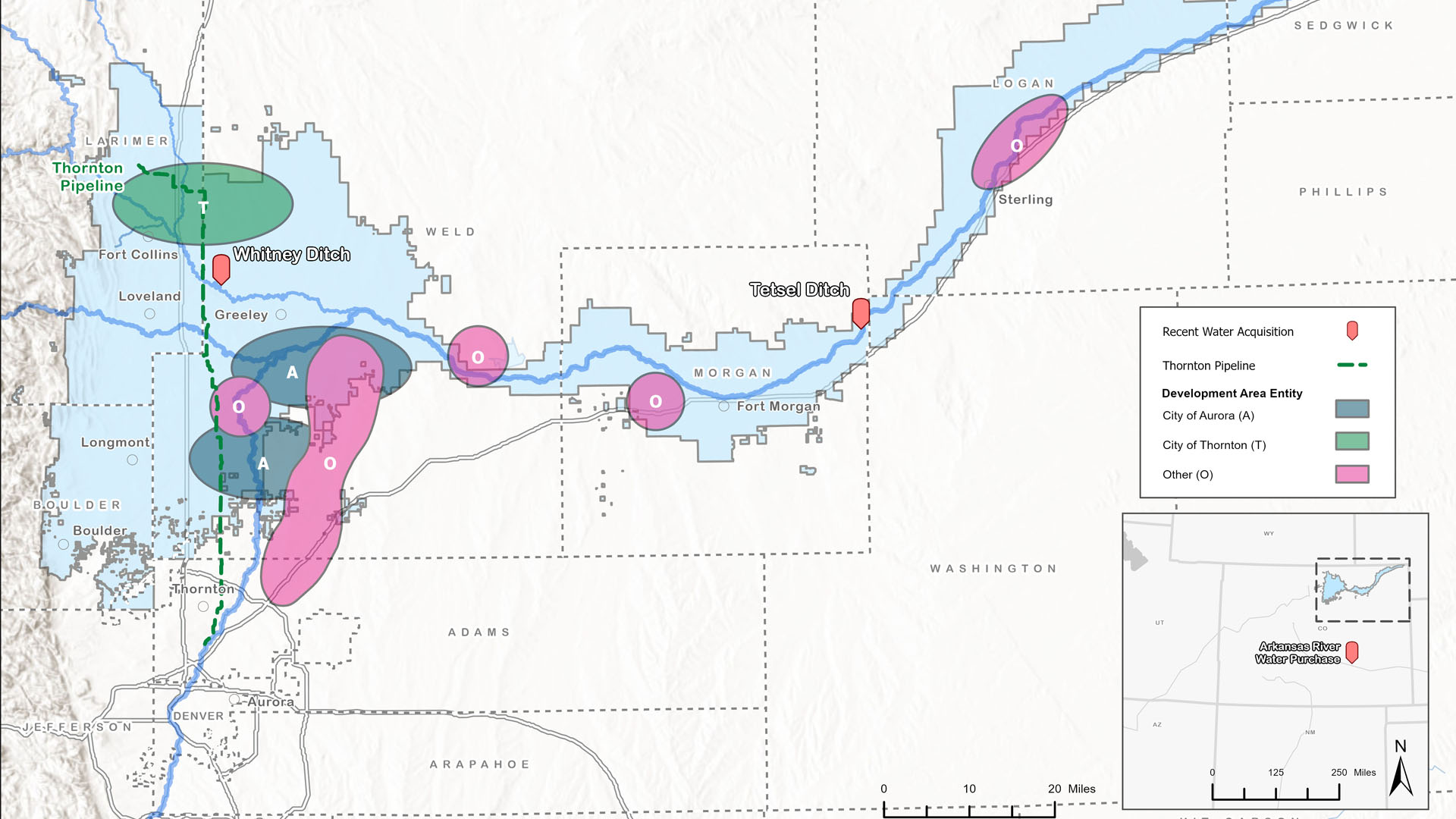
South Platte River Basin Areas
at Risk of Purchase
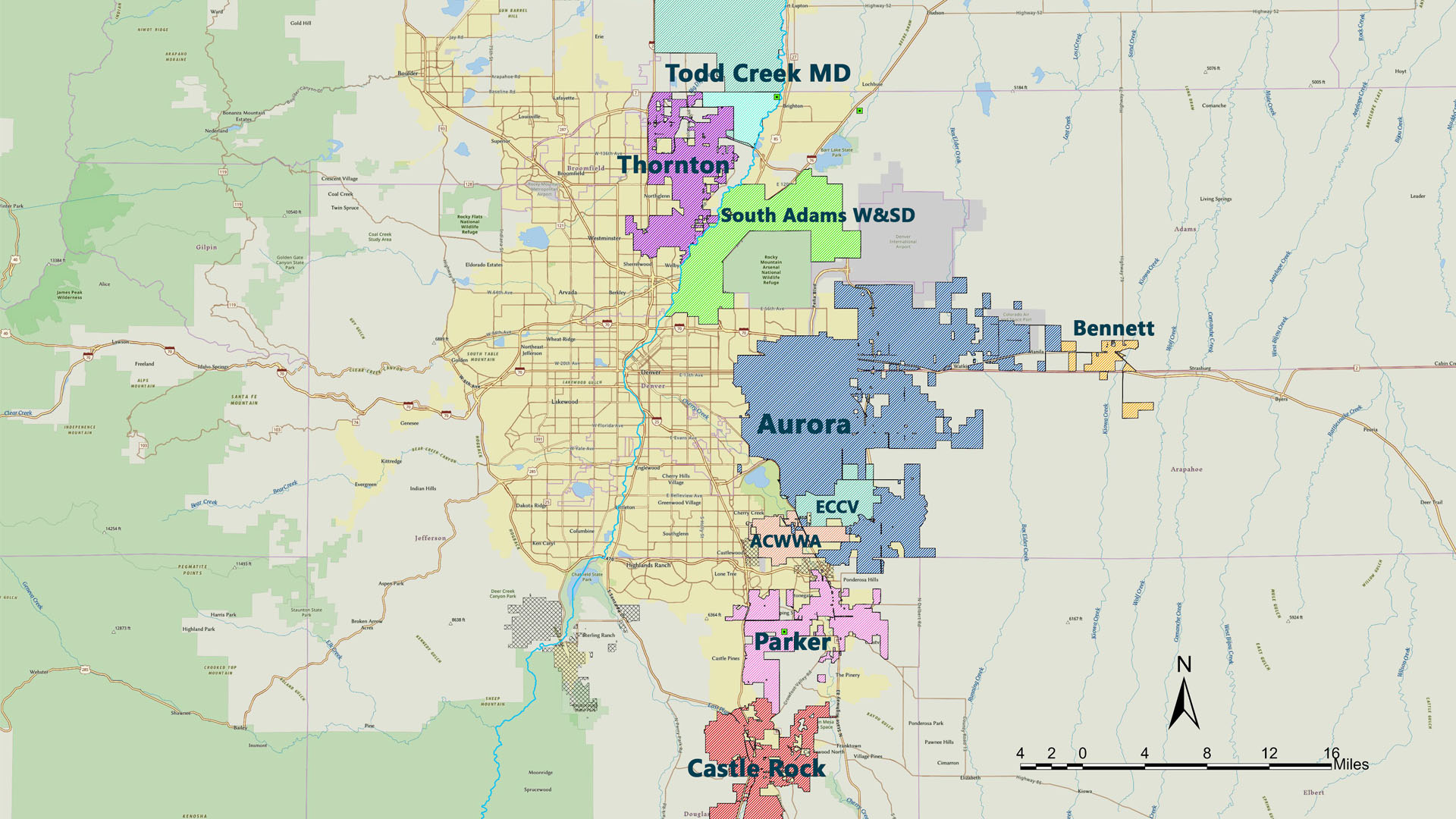
Denver Metro Areas Pursuing Northeastern Colorado Supplies
A New Water Ethos
-
Use Water Wisely
Set a good example for others by eliminating waste, practicing efficiency and stewarding our region’s water resources.
-
Think Local
Consider selling your water and land assets to a local entity or explore options to keep ownership of assets within the region.
-
Share Your Opinion
Communicate the importance of retaining water within our region with your elected officials and water providers.
-
Stay Informed
Visit this website regularly for the latest updates on these efforts and subscribe to our monthly newsletter, E-Waternews.
Increasing Pressures on our Region's
Water Resources
Increasing competition for our region’s water resources is resulting in some of the best land and native water rights in Northeastern Colorado being targeted for acquisition by entities within and around the Denver Metro area. Water is being permanently transferred for use outside of our region mostly through “buy and dry” practices which can have devastating effects to local communities and the environment.
Many of the thirsty cities targeting our region’s water resources are projected to grow rapidly in coming decades but arrived “late to the game” in developing necessary water supplies. Some have developed on non-renewable groundwater that are unsustainable. Other factors such as climate change and strong opposition to developing water from other basins are putting increased pressure squarely on our precious water resources.
Request a Speaker
Water Exports Threaten Northeastern Colorado’s Future
Some communities in Northeastern Colorado are already experiencing the damaging effects of “buy and dry” practices that involve the permanent transfer of water from agriculture to urban end uses located many miles from the historic place of use. Water and land acquired by the City of Thornton in the mid-1980s will start moving to the Denver Metro Area by the end of this decade and the City of Aurora recently acquired water rights from a ditch system that historically irrigated lands now located within the Town of Windsor.
Water transfers present numerous challenges for growing communities in our region including increased water acquisition costs, additional pressures on water rates and housing affordability and reduced water security. For our more rural communities, less water for agriculture means fewer jobs, less vibrant downtowns and greater difficulties operating ditch systems, to name a few.
Before other Front Range communities come into our backyard looking for additional supplies, they should first maximize the use of existing sources by implementing additional water efficiency measures, enacting “smart growth” policies and maximizing water reuse, wherever possible. If water transfers must occur, Northern Water supports appropriate mitigation for the economic, environmental and social impacts to Northeastern Colorado caused by water exports.
The water delivered by the C-BT Project is intended to supplement, or add to, the existing supplies that are derived from the South Platte River and its tributaries. When the C-BT Project was completed in 1957, an amount of water roughly equivalent to two-thirds of the annual flow of the Cache La Poudre River was brought into our region from the Colorado River Basin each year. For nearly 70 years, this supplemental water has complemented native water sources, providing a more reliable supply that supports agricultural, municipal, domestic and industrial uses in Northeastern Colorado.
Maintaining an adequate base water supply supports the economy, environment and quality of life that we enjoy in Northeastern Colorado. It also allows us to maximize the significant investments made in existing and future water projects like the Chimney Hollow Reservoir Project and the Northern Integrated Supply Project (NISP) and helps provide water security for the region in a time of growing uncertainty.
When native water rights are acquired by entities in the Denver Metro Area, we not only lose an asset that contributes to our region’s water security, but also lose the economic, social and environmental building blocks that support vibrant and prosperous communities — both now and into the future. Simply put, when water leaves Northeastern Colorado, wealth, prosperity and opportunity is transferred to the Denver Metro Area.
It is no surprise that water demands are increasing as a result of growth along the Front Range. The Colorado Water Plan states that approximately 70 percent of the state’s population is located along the Front Range and is projected to increase between 42 and 70 percent between 2015 and 2050 [1]. During this same time, the State Demographer’s Office projects that counties in the Denver Metro Area will increase their population by over 840,000 people [2]. The City of Aurora is expecting to see a 40 percent increase in population over the next 20 years, which will translate to a 26 percent increase in potable water demands over this same time [3].
In addition, the southeastern Denver metropolitan area, which includes Arapahoe and Douglas County, has historically relied heavily on non-renewable Denver Basin groundwater to meet its water demands. As these aquifers become depleted, communities are not only charged with finding renewable surface water supplies to meet future needs but must also backfill groundwater supplies which will be lost or greatly reduced over time.
Acquiring water from other basins of the state such as the Arkansas River Basin, Colorado River Basin and San Luis Valley has proven to be nearly impossible in recent years due to strong and determined regional, environmental and political opposition to water exports. This increases concerns by many that the “path of least resistance” for developing water supplies involves exporting water from Northeastern Colorado to the Denver Metro Area through “buy and dry” transfers of water from existing agricultural uses, or by filing junior water rights to take water from the Lower South Platte River.
Some communities in Northeastern Colorado have already experienced the damaging effects of water exports. The City of Thornton acquired approximately 21,000 acres of land and associated water rights in the mid-1980s in Larimer and Weld counties with the intent to transfer agricultural water rights to meet growing demands [4]. Water from the Cache La Poudre River which had previously been used for irrigating nearby food and forage for over 130 years will ultimately depart to Thornton via pipeline by the end of this decade, with transfers averaging 14,000 acre-feet per year by 2065 [5].
In 2020, the City of Aurora acquired 119 shares in the Whitney Ditch Company that are expected to yield approximately 1,629 acre-feet per year of water and at a price tag of nearly $27 million dollars [6]. The water yielded by these shares was historically used to irrigate agricultural lands located on the east side of Windsor, Colorado near the Cache La Poudre River. This acquisition undermined long standing plans by other entities, including the Town of Windsor, to use the water locally for parks, recreation and other amenities. Aurora has recently acquired other supplies in Weld, Washington, Logan and Morgan counties [7] and has plans to opportunistically acquire more supplies from our region in the future. Aurora Water recently reported that it is seeking to acquire and convert approximately 7,000 acre-feet of water rights by 2040, and an additional 12,000 acre-feet of water rights by 2055 [8].
In recent years, water rights have also been acquired in Northeastern Colorado by Parker Water & Sanitation District, the City of Castle Rock and other entities in Arapahoe and Douglas counties. Left unchecked, there is concern that additional water will continue to leave the region one transaction at a time, leaving some of our most productive land and most valuable water rights in the hands of those outside of our local communities.
In simple terms, less water for agriculture means less food and fiber production. This can result in a reduced need for goods and services like farm equipment, seed, labor and transportation which translates to less dollars spent in our local economy. These effects can add up to fewer local amenities, less tax base to support government services, and a more difficult time attracting and retaining businesses in our rural communities over time. The experiences of other areas of Colorado have taught us that as water departs, it not only becomes more difficult to keep small-town main streets vibrant, but it also becomes much more challenging to deliver water through ditch systems, control weeds and maintain infrastructure for those who remain [9].
Colorado’s Northern Front Range is already among the most active, highest-priced water markets in the United States [10]. Increasing competition from the Denver Metro Area for high value water supplies presents numerous challenges for our growing communities including increased water acquisition costs, greater need to participate in timely and expensive Water Court processes and fewer options for developing long-term water supply for growth and drought resilience. These factors can create additional pressures on housing affordability, economic development, and attraction and retention of business and workforce, adding to some of the challenges our region is already facing.
Water users in our region are currently making significant investments in new water projects that seek to meet the current and future water needs of their respective growing communities. If no action is taken to retain the most valuable senior water rights for our continued local use, we run the risk of losing some of our most reliable water supplies to the Denver Metro Area at the same time we are seeking to develop what is likely the last remaining amounts of water in our region using relatively junior water rights. For our region to be successful long term, we not only need to retain the water supplies we’ve worked so hard to develop over the course of decades, but also continue to increase water efficiency and reuse, and thoughtfully develop new water projects, where appropriate.
Northern Water is in the unique position of both delivering water from west of the Continental Divide while also advocating for the preservation of native water supplies in Northeastern Colorado. There are two key distinctions between water imported from the Colorado River and native water supplies that must be considered. First, at the time the C-BT Project was envisioned in the 1930s, excess water supplies had not yet been claimed for use within the Colorado River Basin and were therefore legally and physically available to be used to address chronic water shortages and meet a portion of the supplemental water needs of Northeastern Colorado. In contrast, most of the water has been spoken for in the South Platte Basin. The senior native water rights coveted by the Denver Metro Area have fueled our economy for over 130 years. The beneficial use of water yielded from these rights has resulted in generations of prosperity for our region, which would be forever lost if water leaves for the Denver Metro Area.
Conservancy Districts, including Northern Water, are required to compensate areas where water is taken to reduce the impacts of water transfers [11]. Green Mountain Reservoir and Wolford Mountain Reservoir provide examples of compensatory investments made decades ago by Northern Water and the Municipal Subdistrict to offset impacts and allow West Slope communities to continue to grow and thrive. Today, the operation of these reservoirs and other investments made in local communities continue to provide environmental, economic and social benefits. There are currently no similar requirements for thirsty cities to offset or mitigate the impacts resulting from the export of water from the location of historic use.
Northern Water is a strong advocate for market-based transactions that occur between willing buyers and sellers. A primary goal of Northern Water is to raise awareness about the potential adverse impacts to local economies, the environment and the social fabric of the region when water departs from Northeastern Colorado to other regions. These impacts are often difficult to measure or see when they occur one transaction at a time but accumulate over time and can become significant. We encourage those looking to sell their land and water assets to first consider options like conservation easements or to prioritize selling to willing buyers within Northeastern Colorado instead of selling to entities in the Denver Metro Area who are less invested in the success of our region.
Northern Water desires to work with partners throughout Northeastern Colorado to establish a culture where we think about our neighbors, local communities and region as a whole when making decisions about water. Other regions in Colorado such as the Colorado River Basin, the San Luis Valley and the Arkansas River Basin have been very successful in protecting water resources for the benefit of their citizens by establishing an expectation that it is not acceptable for a fundamental community building block like water to be exported outside of the area where the water originates or has been historically used. In the absence of a similar culture of water preservation, Northeastern Colorado’s water is at risk of becoming the preferred source of water to fuel future growth in the Denver Metro Area.
There are a variety of tools that exist for retaining water resources in our region. These water preservation tools can generally be grouped into one of three categories:
- Education and Outreach – Efforts to increase awareness of the threats to the region’s water supply to foster an appreciation of the importance of preserving water resources for the benefit of Northeastern Colorado and encourage stakeholders to take meaningful action.
- Markets, Incentives and Partnerships – Tools designed to retain water in Northeastern Colorado through voluntary, market-based transactions and partnerships. Examples include conservation easements, dual use water systems and collaborative water sharing agreements.
- Legal and Policy Options – Legal and institutional frameworks that establish a system of rules, standards or regulations. Examples include Water Court decrees, intergovernmental agreements, land use regulations (i.e., County 1041 regulations) and permits.
Keeping water in Northeastern Colorado starts with a desire to maintain what is special about Northeastern Colorado and a commitment to your friends, neighbors and community to maintain our unique sense of place. Northern Water continues to collaborate with partners to explore tools that help retain water resources for the current and future benefit of Northeastern Colorado.
There are many ways to become involved in protecting our region’s precious water resources. Included below are a few examples of what you can do to help protect our water resources for current and future generations:
- Set a good example – use water wisely.
- Educate yourself to understand the economic, social and environmental values water provides and the consequences when water leaves the region.
- Help us establish a regional water ethic focused on identifying shared values around water and protecting what makes our region special.
- Let’s set an expectation that water is too important to the future of our region to let it go south!
- Share your viewpoint with your county commissioner, city council member, local water provider, ditch company board member or community association.
- Submit a letter to the editor for your local newspaper.
- View the latest updates on Northern Water’s efforts to preserve water supplies for the benefit of Northeastern Colorado on this webpage, to request a speaker to learn more about this important topic, or to sign up for Northern Water’s E-Waternews newsletter and other updates.
Check back frequently for additional information and resources for how you can learn more about water preservation and become more involved in protecting the region’s water resources.
FAQ Sources
[1] Colorado Water Plan, South Platte Basin Overview, page 123
[2] State Demographer’s Office Population Projections (2022-2050), July 2023
[3] Integrated Water Master Plan Update (IWMP2) Summary, Aurora Water Policy Committee, July 12, 2024
[4] Northern Properties Stewardship Plan | City of Thornton
[5] Community Engagement - Thornton Water Project
[6] Aurora City Council Meeting Packet, July 20, 2020, Page 43
[7] Aurora inks $43.7 million in water deals on South Platte River - Water Education Colorado
[8] Integrated Water Master Plan Update (IWMP2) Summary, Aurora Water Policy Committee, July 12, 2024
[9] High + Dry - 5280
[10] Northern CO needs new water market benchmarks - Colorado Real Estate Journal
[11] The 1937 Water Conservancy Act (C.R.S. § 37-45-118) which enabled the creation of Water Conservancy Districts like Northern Water requires projects (including the C-BT Project) to be designed, constructed and operated in a manner that does not impair existing and future uses of water in the Colorado River Basin, the natural basin from which water is diverted.